BIGGER PICTURE Scientific discovery
A burnt scroll speaks again—without being opened
A fragile lump of carbon held a philosopher’s words for nearly two millennia. X-rays, machine learning and papyrologists turned part of its hidden surface into readable text.
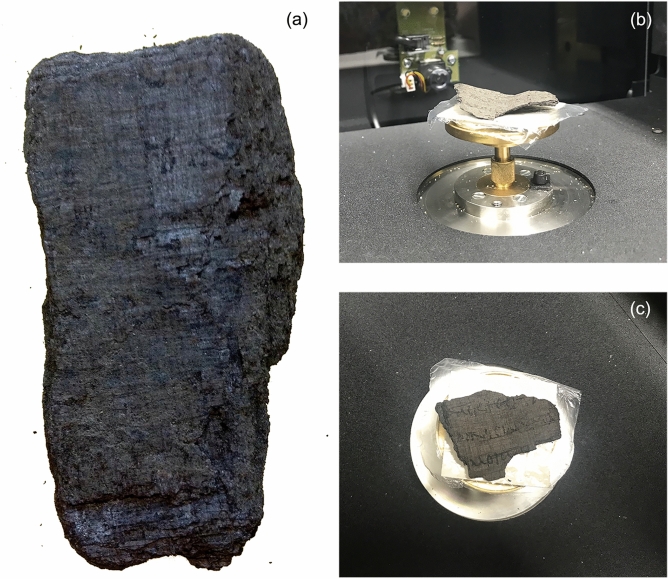 Original photograph
- First major milestone
- February 2024
- Recovered writing
- >2,000 characters
- Physical unrolling
- None required
How the idea works
Scan the sealed scroll
X-rays capture the layers without opening them.
Unwrap its digital surface
Trace and flatten the hidden papyrus sheet.
Recover ink traces
Local ink predictions become text for expert reading.
The book that cannot be opened
The Herculaneum scrolls were carbonized when Vesuvius erupted in AD 79. Physically separating their crushed layers can destroy the writing. The Vesuvius Challenge approached the problem as a preservation task: recover information while leaving the object intact. The winning result from its 2023 competition, announced in February 2024, revealed more than 2,000 characters across 15 partial columns of one scroll.
Sources: [1]
Flattening a surface inside a lump
X-ray tomography records the scroll as a three-dimensional volume. Researchers trace the folded papyrus surface inside that volume, then flatten its digital representation. This produces a map of a page that remains physically rolled up. Exposed fragments, photographed with infrared light, provide examples linking visible ink to features in the scan.
Sources: [2]
Detect ink, then let people read
The model predicts small ink-bearing regions; it does not compose plausible ancient Greek. Those local predictions assemble into letter shapes that papyrologists interpret. Independent teams produced closely matching images, and reviewers reproduced the winning code. The recovered discussion concerns pleasure, food and music—ordinary human interests arriving from an otherwise inaccessible ancient library.
One breakthrough is not every scroll
The project’s July 2025 assessment reported an important boundary: ink signatures that worked on readable scrolls did not generalize across the collection. Tracing compressed layers also remained laborious. The demonstrated benefit is already remarkable—new historical evidence without destructive opening—while reading the whole library requires further advances in scanning, surface reconstruction and ink detection.
Sources: [3]
The original sources
- Vesuvius ChallengeVesuvius Challenge 2023 Grand Prize awarded
- Vesuvius ChallengeThe Tutorials: virtual unwrapping pipeline (archived)
- Vesuvius ChallengeMaster Plan: Stage Two (historical assessment)