BIGGER PICTURE Scientific discovery
Six missing letters, and an ancient alliance reappears
A broken stone can preserve a law, a treaty or a person’s voice while losing the words that explain it. Ithaca helps historians explore plausible restorations, places and dates without hiding uncertainty.
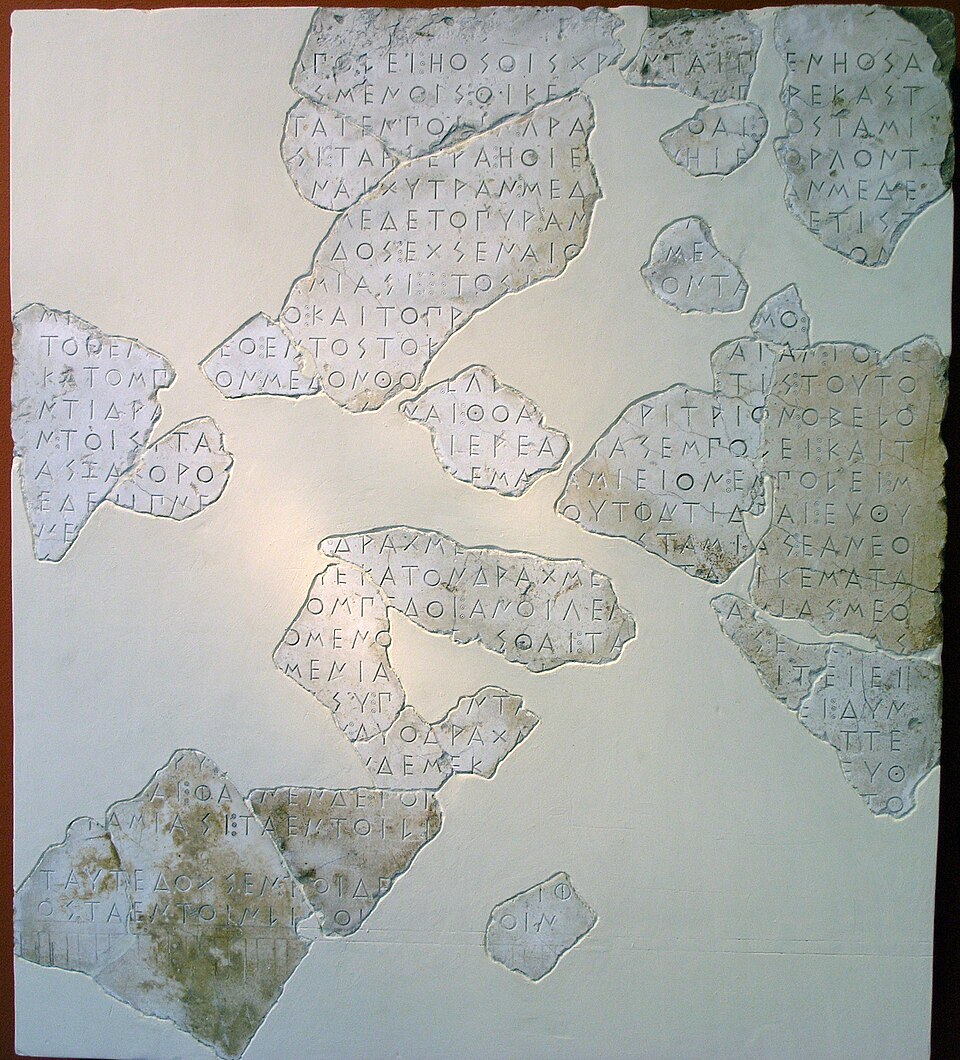 Original photograph
- Restoration task
- Historians: 25% → 72% with AI assistance
- AI alone
- 62% restoration accuracy
- Public access
- Free interactive tool and open code
How the idea works
Read the surviving inscription
Words and characters provide historical context.
Rank restorations and origins
The model offers alternatives with date and region distributions.
Let historians test the hypotheses
Experts compare suggestions with linguistic and historical evidence.
A blank in a treaty becomes a testable suggestion
In one demonstration, an Athenian inscription had six missing characters in a word describing its relationship with Thessaly. Ithaca ranked the Greek word for alliance first and highlighted context supporting it. Other proposals remained visible. The result was not a magically recovered photograph of the original: it was a set of informed hypotheses.
Sources: [2]
Read the surviving words and characters together
The neural network was trained on digitised Greek inscriptions and considered both complete words and individual characters. It also estimated regional origin and date ranges. Probability distributions and highlighted passages helped specialists inspect why a suggestion appeared plausible. The released code and dataset-processing instructions allow other researchers to examine the method.
People and model performed better together
In the restoration evaluation, historians’ accuracy rose from 25% alone to 72% with Ithaca; the model alone reached 62%. The team also examined disputed Athenian decrees. Its average suggested date, 421 BCE, aligned with historians’ newer evidence for the 420s rather than the older pre-446/445 dating. That supports a debate; it does not settle it automatically.
Sources: [1]
Keep alternatives visible
The benefit reaches historical research, teaching and access to cultural records. Its most transferable feature is the interface: show several plausible answers and the uncertainty around them, then let an expert weigh external evidence. A missing word is precisely where confident invention is dangerous. Here, usefulness comes from making interpretation more inspectable.
The original sources
- University of OxfordOxford historians apply state-of-the-art AI to ancient texts
- Google DeepMindPredicting the past with Ithaca
- Google DeepMind / research collaboratorsIthaca: code, pretrained model and dataset workflow