BIGGER PICTURE NASA
Why NASA’s AI-designed parts look like bones
 Original photograph
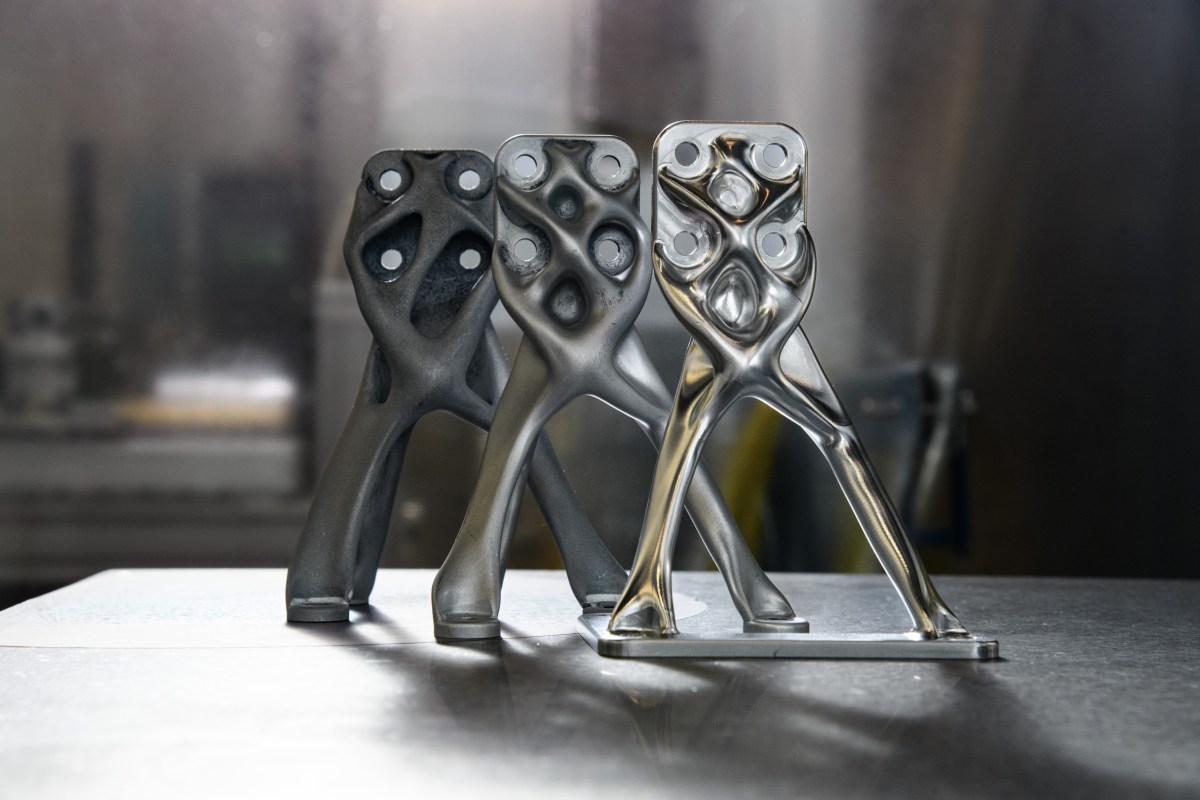
Those curved metal branches have a job: hold scientific instruments steady while carrying less weight. NASA’s engineers set the requirements. AI explores shapes that satisfy them.
- Reported mass saving
- Up to two-thirds
- EXCITE bracket comparison
- Over 3× stiffness-to-mass measure
- Evidence
- 2022 paper · 2023 NASA report
Why the bone-like shape?
Look at the bolt holes first. They are the fixed points; the curved struts connect them. Engineers specify loads, attachment surfaces and spaces that must remain clear. An optimisation process removes material where it contributes little to carrying those loads. The result can look grown rather than assembled from straight plates.
The software still needs an engineer’s judgement. NASA warns that unconstrained designs can become too thin.
What do these parts actually hold?
EXCITE is a balloon-borne telescope for studying planets around other stars. Its tip/tilt bracket supports an assembly that directs telescope light towards a guiding camera and a science detector. It must leave the light path clear and withstand the loads of the balloon mission.
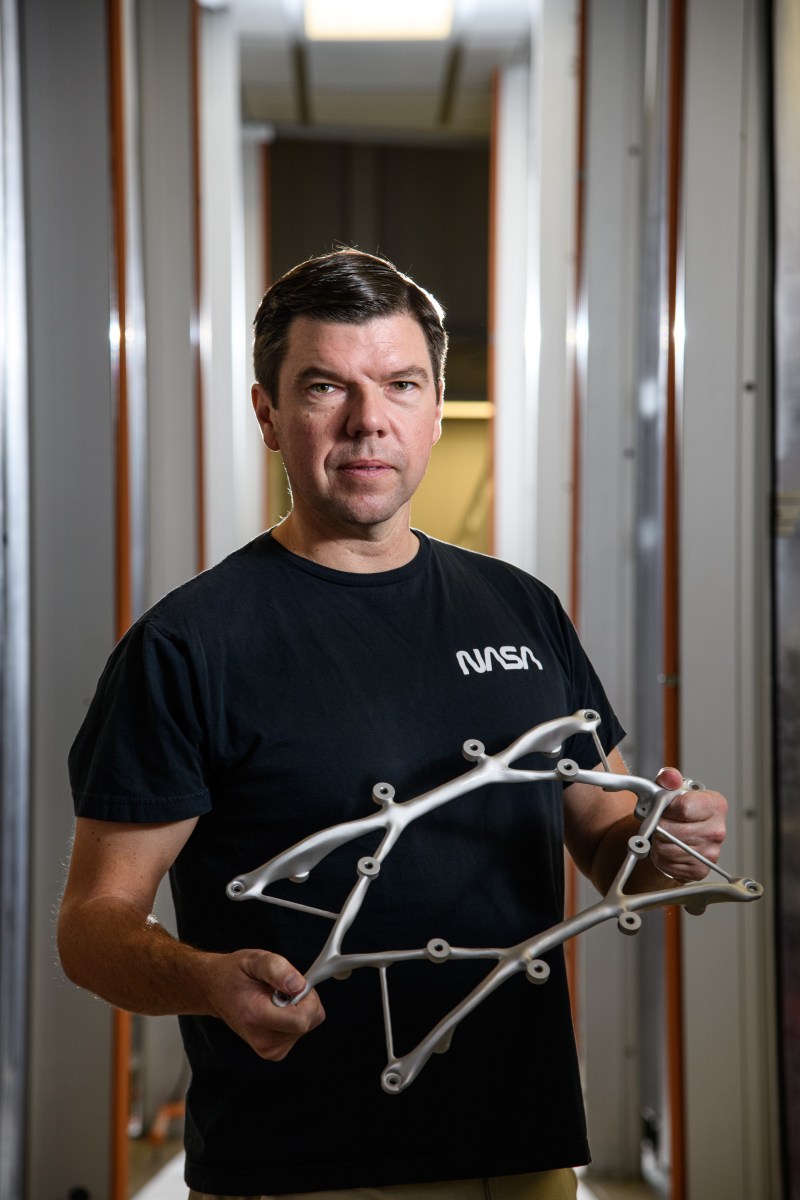
A separate titanium scaffold connects an infrared receiver in an aluminium cryogenic chamber to a carbon-fibre plate supporting the main mirror. Those materials expand differently with temperature. The interface must accommodate that difference without stressing them.
 Original photograph
Titanium, aluminium—and two ways to make them
The large mount in McClelland’s hands is 3D-printed titanium. The EXCITE bracket study also tested aluminium: machined versions used 6061-T651; printed versions used AlSi10Mg and A6061-RAM2. The unusual appearance does not require an exotic new substance. Some shapes can be cut from metal; others suit additive manufacturing.
NASA’s examples also include optical benches, radiator brackets and detector mounts. These are tailored structures for particular instruments, each with its own constraints.
How much better—and by which measure?
NASA’s 2023 report describes weight reductions of up to two-thirds and a prototype cycle as short as one week. In the 2022 EXCITE comparison, the AI designs exceeded three times the paper’s stiffness-to-mass measure for the relevant human-designed comparator.
The team also reported lower calculated stress concentrations. That is a different measure from breaking strength: it does not mean every part is ten times stronger. Manufacturing and material properties matter; in the bracket tests, the machined specimen was stronger than the printed specimens, while the printed design was stiffer.
These are documented engineering examples, not a universal improvement factor. A flight part still needs analysis, inspection and qualification for its particular mission.
The original sources
- NASA · article and photographsNASA Turns to AI to Design Mission Hardware (9 February 2023)
- NASA Goddard · engineering paper and test resultsGenerative Design and Digital Manufacturing: Using AI and robots to build lightweight instruments (2022), sections 2–4
- NASA · application examplesEvolved Structures: Using AI and robots to build lightweight spaceflight structures
- NASA Goddard · process and capabilitiesGenerative Design — Goddard Engineering and Technology Directorate