BIGGER PICTURE Accessibility & independence
A prosthetic knee learned its wearer's walk in about ten minutes
A powered knee can supply movement, but its settings must fit the person wearing it. Researchers explored whether the prosthesis could learn that fit while its user was already walking.
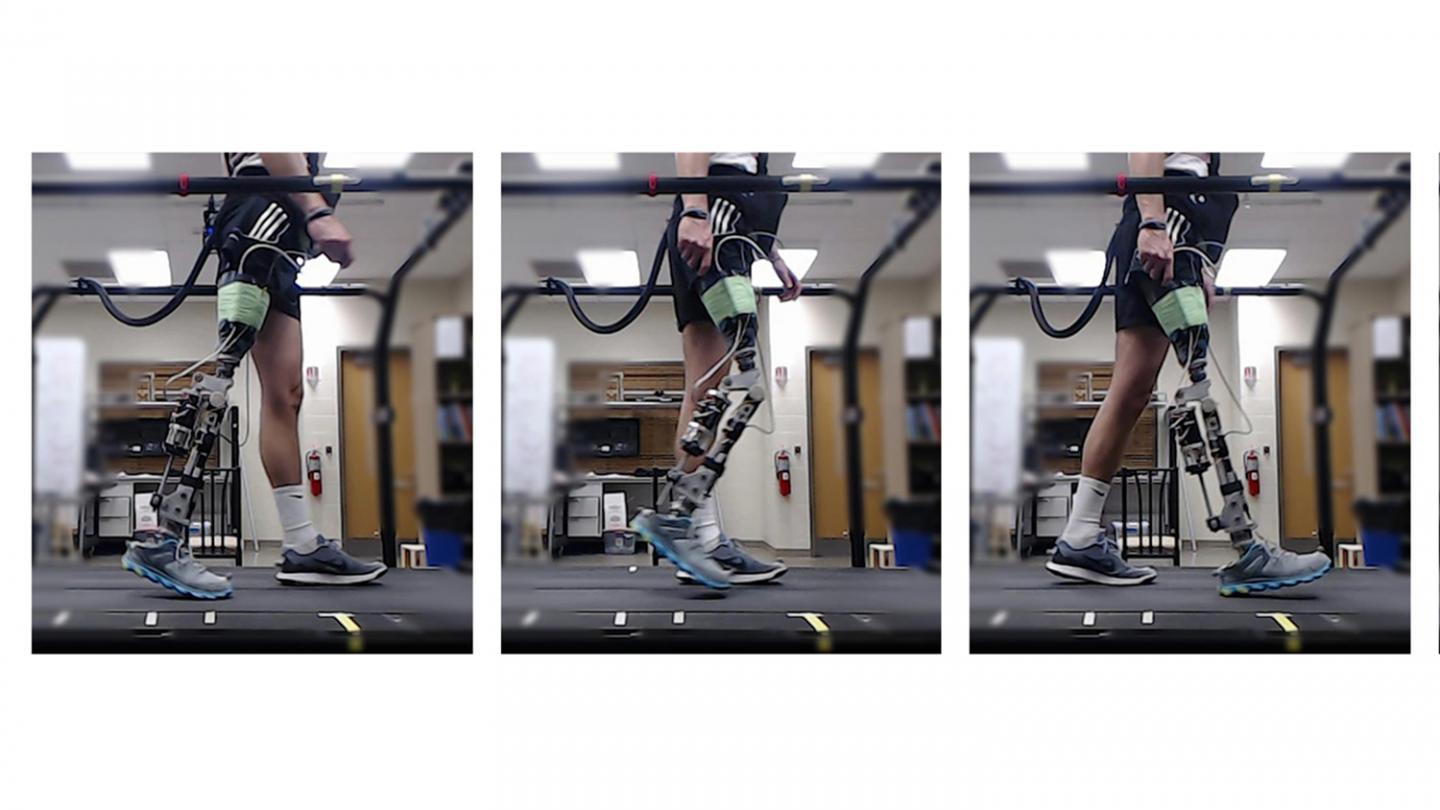 Original photograph
- Adjustable settings
- 12
- Average tuning time
- About 10 minutes
- Initial study
- 2 participants on a treadmill
How the idea works
Measure the step
Knee sensors record movement through the gait cycle.
Learn the adjustment
Reinforcement learning compares knee motion with its target.
Retune while walking
The controller updates stiffness and other parameters across the step.
The person changes along with the machine
A robotic knee needs different stiffness and movement settings during different parts of a step. Adjusting them is difficult because the person also changes how they walk in response to the prosthesis. A fixed mechanical model cannot fully describe that interaction.
Each walk becomes feedback
The team used reinforcement learning to adjust twelve control parameters. Sensors recorded the knee's movement; the algorithm compared it with a target walking pattern, learned which adjustments helped, and tried improved settings while the participant continued walking.
A small experiment with a practical result
In one participant with an amputation and one without, the system reached its target knee motion after an average of roughly 300 gait cycles, or ten minutes. The 2019 study demonstrated automatic tuning on a treadmill at a fixed speed.
Sources: [1]
The next challenge is what the wearer wants
The target was a reference knee movement, not a complete measure of comfort, balance or personal preference. Stairs and everyday walking were outside this experiment. Its contribution is a way to reduce repeated manual adjustment while allowing a person and an assistive machine to adapt together.
Sources: [2]
The original sources
- IEEE Transactions on CyberneticsOnline Reinforcement Learning Control for the Personalization of a Robotic Knee Prosthesis
- North Carolina State UniversityReinforcement Learning Expedites ‘Tuning’ of Robotic Prosthetics