BIGGER PICTURE Accessibility & independence
A robotic boot learns from forty-four steps at a time
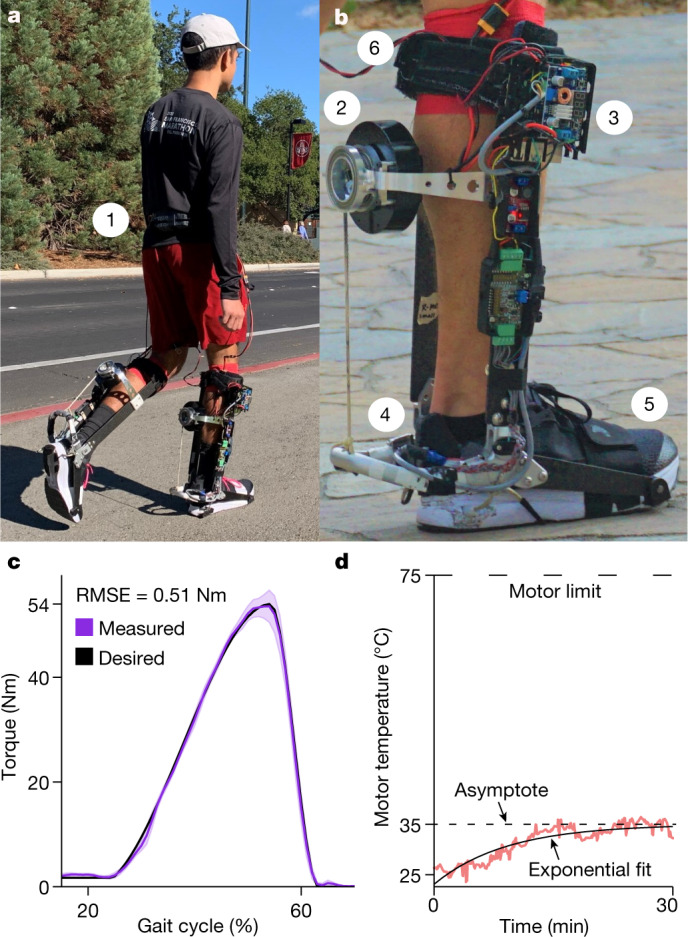
Walking to catch a bus is different from strolling with a dog. Stanford's ankle exoskeleton was designed to learn across those changes, giving its wearer a personalised push without remaining tethered to laboratory equipment.
 Source illustration
- Outdoor participants
- 10 healthy adults
- Walking speed
- 9% faster than normal shoes
- Energy per distance
- 17% less than normal shoes
How the idea works
Learn the metabolic clue
Lab data links ankle motion and assistance with energy expenditure.
Compare each push
Wearable sensors let a model rank timing and force settings.
Adapt on the path
The portable motors update assistance as the wearer changes pace.
A well-timed push at the ankle
A motor pulls a cable that helps the ankle push off the ground. Timing and strength matter: assistance that helps one walker can be poorly matched to another. The portable device carries its own power, allowing the wearer to leave the treadmill.
The lab teaches the boot what to notice
Earlier laboratory experiments connected ankle movements with measured energy expenditure. A model learned to compare assistance settings using motion sensors. Outdoors, it could estimate which settings were better without a breathing mask measuring metabolism. It tested new parameters after each 44 continuous steps.
Sources: [1]
An hour of ordinary starts and stops
Ten healthy adults tested the system on a public route, changing pace and stopping along the way. After an hour of adaptation, they chose a walking speed averaging 9% higher and used 17% less energy per distance than with normal shoes.
A demonstration before a mobility treatment
The 2022 experiment established assistance outside the laboratory, not a treatment result for a particular disability. Testing with older people or people with mobility impairments remained a separate task. The engineering advance was making personalisation work through short, varied bouts of real walking.