BIGGER PICTURE Accessibility & independence
The brain implant that became Casey’s everyday voice
More than 3,800 hours at home: Casey Harrell used a brain interface to communicate when he chose, without a researcher beside him. The striking change was making an experimental voice part of ordinary life.
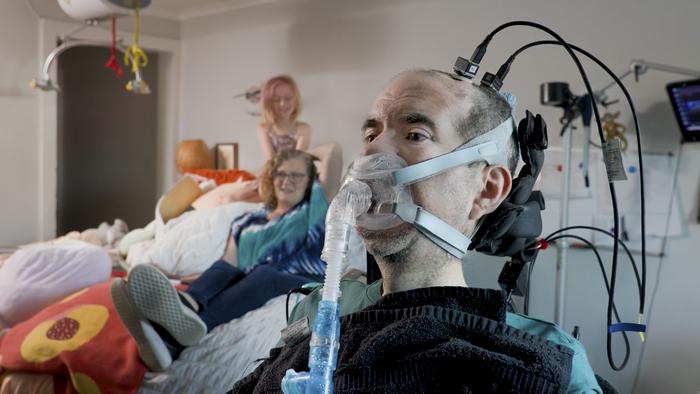 Original photograph
- Independent home use
- 3,800+ hours
- Average communication rate
- 56 words/minute
- Clinical evidence
- One participant · 2026
How the idea works
Attempt speech
Electrodes capture speech-related cortical activity.
Decode words
Trained networks turn neural patterns into text.
Communicate and control
Speech output and cursor control connect to everyday computer tasks.
A conversation whenever he chooses
Casey Harrell’s ALS made his speech difficult to understand and weakened his limbs. The 2026 study documents something beyond producing test sentences: he used the interface to talk with family and colleagues, send messages, browse online and continue working. Those ordinary activities are the practical achievement.
Sources: [2]
The intention to speak remains useful
Implanted electrodes recorded activity in his speech motor cortex. Neural networks translated attempted speech into words; another decoder enabled cursor control. Text could also be spoken using a synthetic version of his pre-ALS voice. This reads task-related signals from trained movements, not arbitrary private thoughts.
Sources: [1]
From supervised sessions to daily use
Over nearly two years, Harrell communicated almost two million words at an average of 56 words per minute. Trained caregivers connected and started the equipment; he then operated it without researcher supervision. Manageable setup and stable decoding mattered alongside improving the neural network itself.
Precision in tests and everyday conversation
Word accuracy exceeded 99% in controlled tests of attempted speech using prompted sentences, but everyday conversation was less accurate and included user corrections. This remains an implanted investigational system tested in one person, with bulky equipment and caregiver setup. Its strongest evidence is sustained personal usefulness, not a ready-made solution for everyone with ALS.
Sources: [1]