BIGGER PICTURE Accessibility & independence
A digital detour around a spinal injury
For Gert-Jan Oskam, the achievement included something ordinary: standing at a bar with friends. A brain–spine interface helped return voluntary control over movements that his injury had interrupted.
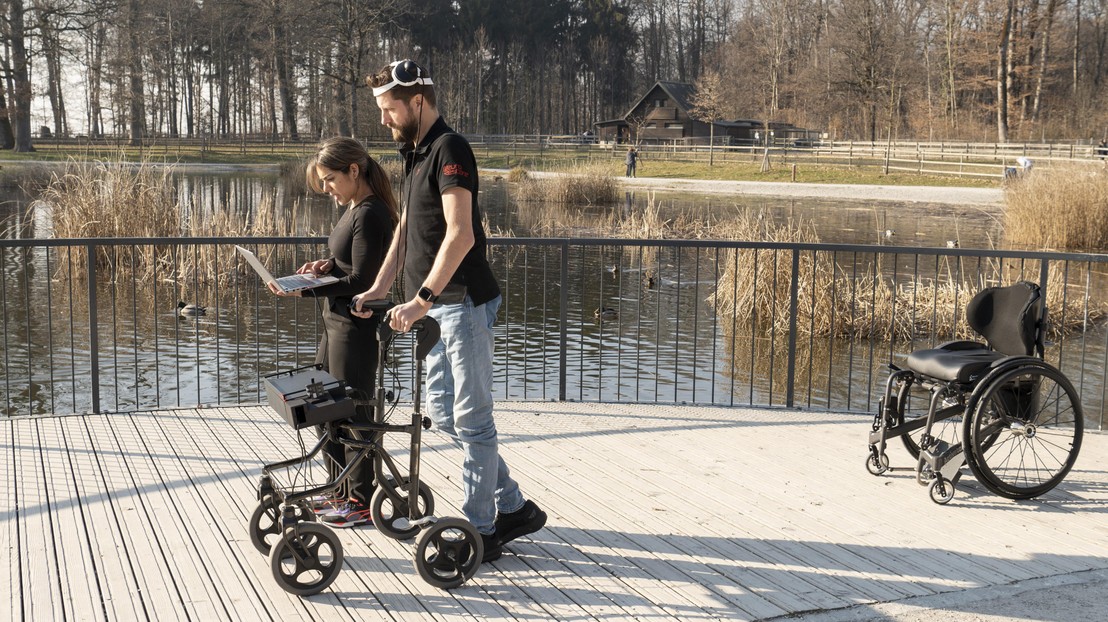 Original photograph
- Published demonstration
- 2023
- Implant functions
- Record intention · stimulate spinal circuits
- People in this study
- One
How the idea works
Record movement intention
Brain implants detect leg-related neural activity.
Translate into stimulation
Adaptive decoding selects the spinal stimulation pattern.
Recruit leg movement
Spinal stimulation and practice support voluntary movement.
The intention and the muscles needed a connection
Oskam had a chronic, incomplete spinal cord injury. His brain could still form movement intentions, but the normal route toward leg control was damaged. The researchers built an alternative connection using implanted recording devices above the leg-related brain region and a stimulator targeting spinal circuits involved in walking.
From movement intention to a pulse sequence
Adaptive algorithms decoded the recorded signals into intended movements. Those estimates controlled sequences of electrical stimulation below the injury. The stimulation helped recruit the circuits and muscles for the chosen action. Wireless communication linked the components; the patient still used physical support when walking. The result was a controllable bridge, not a repaired spinal cord.
Starting, stopping and changing the task
The demonstration included standing, walking over different terrain and climbing stairs with assistance. Brain control connected stimulation to his intention rather than asking him to follow a fixed external pattern. Training was integral. Some motor improvements remained when the interface was switched off, an intriguing finding that still requires careful interpretation.
What Oskam’s experience establishes
This was one participant with an incomplete injury, implants and extensive rehabilitation. The study cannot establish that the same approach restores walking after every spinal injury. Its contribution is more precise: a person's surviving neural signals can control assistance in real time, making the person an active director of the movement.
Sources: [1]