BIGGER PICTURE Accessibility & independence
The feeding robot met its hardest test at home
A forkful of food is only part of a meal. At home, Jonathan Ko eats while working, watching television or sitting in different positions. ADA had to fit those routines, not just move a fork accurately.
- Home evaluation
- 10 meals over five days
- User choice
- Select the next bite in a web app
- Control
- Customisable autonomy and emergency stop
How the idea works
Choose a bite
The user selects food in the plate view.
Acquire and position
Vision, learned acquisition actions and force sensing guide the fork.
Transfer on the user’s terms
Adjustable control lets the person set pace and intervene.
Choose the bite, not just the menu
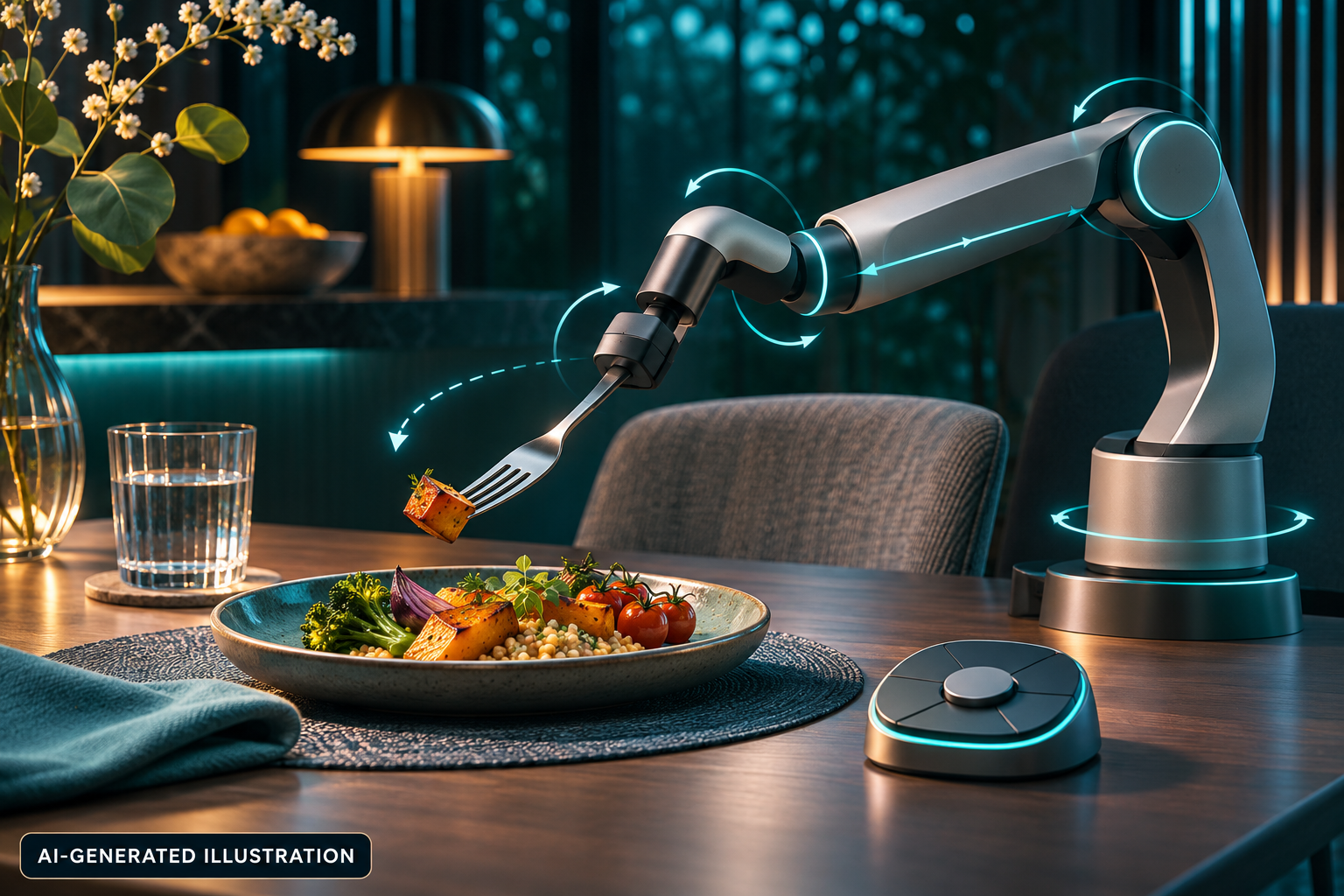
ADA combines a robot arm, camera and force sensor. The user selects a bite through an accessible web interface; the system identifies the food and moves the fork toward the mouth. The goal is to let someone with limited arm movement direct their own meal.
Sources: [1]
Ten meals reveal what a laboratory cannot
In the home study, community researcher Jonathan Ko used ADA for ten meals over five days. The research included eating in bed, at a table and while watching television. Dim lighting and changing furniture arrangements exposed problems that a fixed laboratory setup would not reveal.
Sometimes less autonomy gives the person more control
Ko adjusted the robot’s resting position and could manually guide part of the transfer when face detection was unreliable. He also chose when to bring a prepared bite to his mouth while working. The system’s useful intelligence included making room for those user-devised solutions.
Sources: [2]
Eating independently still involves a surrounding care setup
Caregivers remained available, and practical setup and occasional assistance were still needed. This was a small research deployment, not a ready-made replacement for care. Its achievement is concrete: full meals outside the lab, with the person influencing pace, position and the balance between automatic and manual control.
The original sources
- University of WashingtonThe UW’s assistive-feeding robot gets tested outside the lab
- University of Washington research project / HRI2025Lessons Learned from Designing and Evaluating a Robot-Assisted Feeding System for Out-of-Lab Use