BIGGER PICTURE Accessibility & independence
He opened a cabinet with a robotic arm controlled by brain signals
A man paralysed after a stroke moved blocks, opened a cabinet and held a cup beneath a water dispenser. The less visible breakthrough was keeping his brain interface useful across months.
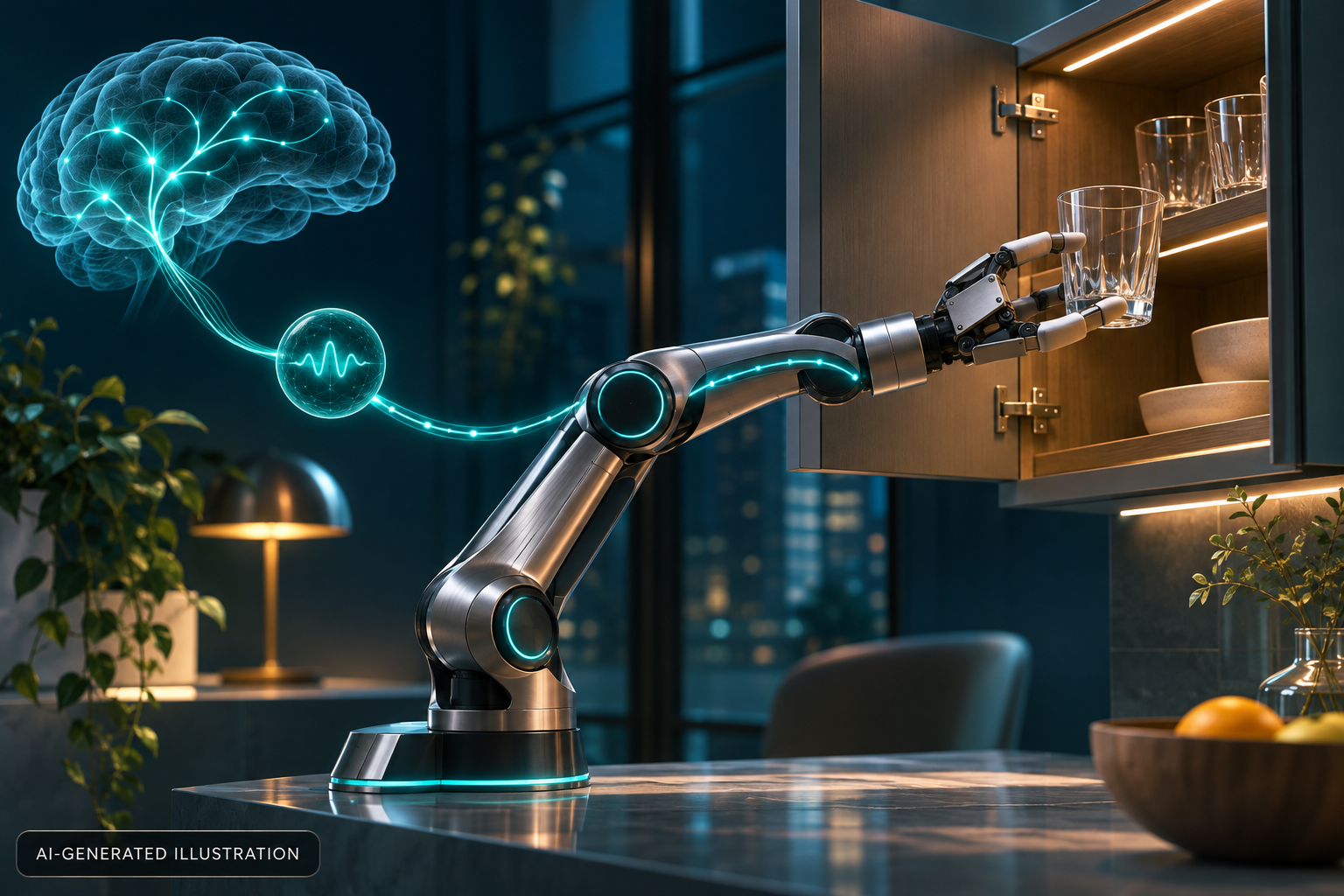
- Demonstration
- Reaching, grasping and releasing
- Duration
- Robotic control over seven months
- Setting
- Research sessions, not independent home use
How the idea works
Sample imagined actions
Surface electrodes record imagined hand and finger movements over several days.
Learn the stable relationships
The decoder learns movement patterns despite shifts in neural activity.
Move and observe
Decoded commands move the arm; visual feedback supports practice.
Yesterday’s signal is not quite today’s
A decoder trained on one day can struggle when brain activity shifts later. UCSF researchers studied these changes rather than treating them only as noise. Representations of imagined movements kept a recognisable overall structure even as their positions shifted in the recorded activity.
Sources: [2]
First imagine the fingers; then move the machine
The participant imagined hand and finger movements while implanted electrodes recorded signals. Training across days exposed the model to variation. He then practised with a virtual arm and feedback before controlling a physical robot that could reach, grasp and release objects.
From a block to a cup at the dispenser
Moving a cup beneath a dispenser connects decoding accuracy with an ordinary task. The reported robotic control extended over seven months. The institutional account also describes a short tune-up after a break, so the achievement should not be read as permanent operation with no maintenance.
Sources: [1]
The remaining distance to a kitchen at home
The robotic demonstration involved one participant with severe paralysis. Bringing the system into daily life at home was a next research step in the 2025 report. The inspiring result is a strategy for making assistance persist as biology changes, rather than requiring a completely fresh start each day.
Sources: [1]