BIGGER PICTURE Scientific discovery
The robot that crushed 25,000 shapes to find a better cushion
MAMA BEAR’s job is destructive: print a small shape, squeeze it, learn from the force curve and try again. The result was a geometry the researchers had not expected.
 Source illustration
- Physical experiments
- >25,000
- Measured efficiency
- 75.2%
- Design variables
- 11
How the idea works
Choose a shell geometry
The optimizer proposes dimensions and shape parameters.
Print and compress
Robotics measures the real force–deformation response.
Learn the next design
Measured efficiency guides the next physical experiment.
Protect something by letting the structure collapse
A protective structure must absorb energy without transmitting a force that damages the object or person behind it. Simply making it harder is not enough. Boston University’s team explored polymer shells that bend, buckle and contact themselves during compression—behaviour sufficiently complicated that a dependable physical experiment was more useful than an optimistic simulation.
Sources: [1]
A laboratory that chooses its next experiment
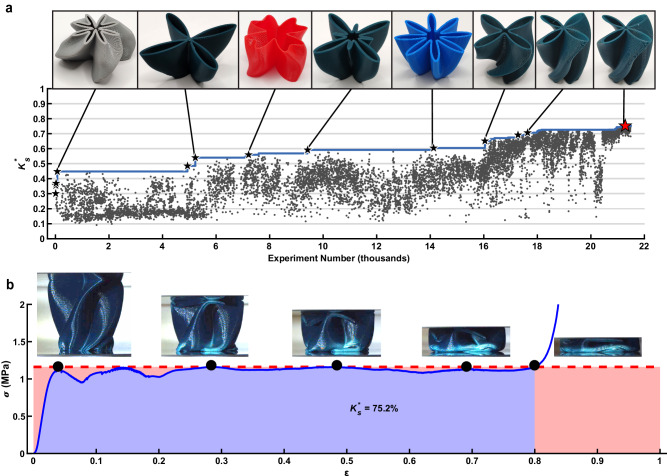
The automated setup connects 3D printers, a robot arm, weighing and imaging equipment, and a compression tester. Bayesian optimization selects designs from an enormous space of geometric variations. After each test, the measured result informs the next choice. Researchers monitored the campaign and modified the system when needed; the achievement was a human–laboratory partnership.
Four petals, a surprising force curve
In a campaign that ultimately included more than 25,000 experiments, the team identified a PLA-plastic structure whose best individual test reached 75.2% energy-absorbing efficiency. The university describes a roughly 2.6-centimetre shape with four thin, petal-like points. Earlier candidates resembled clovers, butterflies and starbursts. The useful result is not its appearance, but its ability to keep absorbing energy before the specified stress threshold is exceeded.
From a crushed sample to protective design
The data informed work on helmet padding, but that padding used a different, softer geometry. The headline efficiency is a laboratory metric, not a 75% reduction in injuries. The broader opportunity is a library of tested shapes and design principles for cushioning and packaging. It shows how AI can discover useful physical behaviour by learning directly from material failure.
The original sources
- Nature Communications / author-hosted paperSuperlative mechanical energy absorbing efficiency discovered through self-driving lab-human partnership
- Boston University, The BrinkA Robot on a Mission
- Boston University Annual Report 2024A Self-Driving Lab