BIGGER PICTURE Scientific discovery
Concrete that gets strong sooner—with less carbon
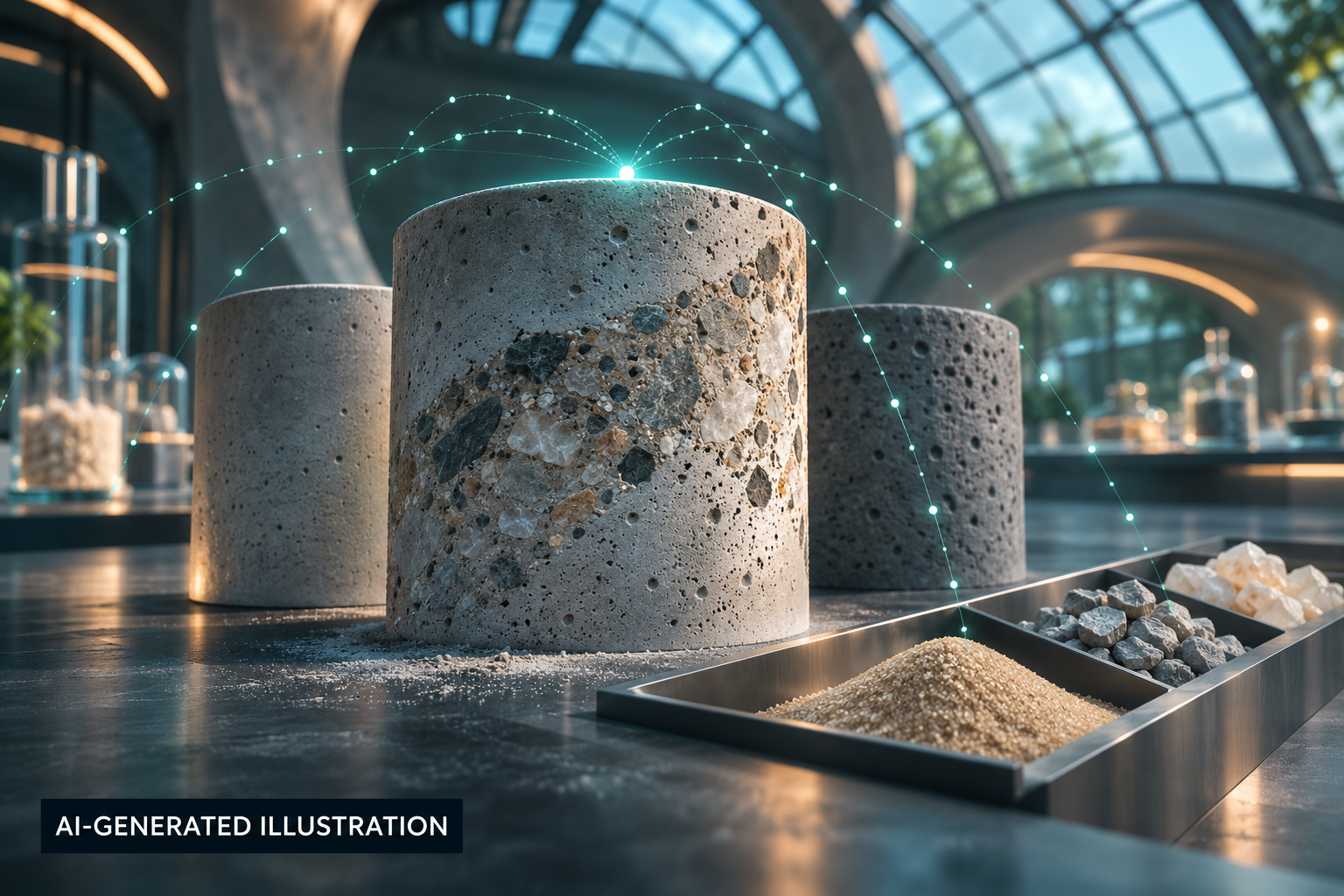
The recipe had to do more than survive a laboratory test. It had to pour, finish and harden into a usable floor slab. AI helped researchers improve several of those demands together.
- Early strength versus baseline
- +43%
- Carbon intensity versus baseline
- −35%
- Real application
- A Rosemount data-centre slab section
How the idea works
Measure local mixes
Record strength over time and ingredient-related carbon.
Choose informative experiments
Bayesian optimization proposes recipes balancing several goals.
Qualify a real slab
Test workability and finish before construction use.
The waiting problem in a concrete recipe
Concrete needs time to reveal its strength. The standard 28-day measurement cannot simply be made instantly by using a faster computer. That makes every poorly chosen experiment expensive. The researchers treated mix design as a search across several competing goals, including early strength and the carbon footprint associated with the ingredients.
Sources: [3]
Mix, crush, learn, mix again
Illinois researchers made starter mixes, measured their performance and fed the results into a model. Bayesian optimization proposed the next promising combinations of cement, supplementary binders, water and aggregates. Real tests then corrected the predictions. The model learned from more than 100 recipes; it was not asked to invent a universal concrete formula from text.
A result a contractor could actually use
After Amrize’s final checks, Illinois reported 43% higher early strength and 35% lower carbon intensity than the industry baseline mixture, with comparable workability. Practical finishing matters: a floor must be smooth and level, not merely strong. Amrize and contractor Mortensen tested those properties before a formulation was used in a support section of a Rosemount data-centre slab.
A local recipe, an adaptable method
The comparison concerns a particular material mix and baseline, not all concrete or an entire building’s emissions. Available binders also vary by region. The reusable advance is the open-source optimization workflow: define local constraints, learn from small batches, then qualify the promising material at construction scale. Expert approval remains part of the process.
The original sources
- Meta EngineeringUsing AI to make lower-carbon, faster-curing concrete
- University of Illinois Urbana-ChampaignRecipe for success: AI-optimized concrete
- Research authors / arXivSustainable Concrete via Bayesian Optimization