BIGGER PICTURE Scientific discovery
A robot chemist discovered when less light works better
RoboChem mixes tiny reaction volumes, shines controlled light through them and measures what comes out. Its next experiment is chosen from the actual result, not from a fixed laboratory recipe.
- Reaction volume
- About 650 microlitres
- Revisited literature
- Four selected papers
- Higher yields in the comparison
- About 80% of cases
How the idea works
Mix a tiny flow reaction
Reagents pass through a controllable illuminated reactor.
Measure the actual products
Inline NMR reports reaction performance.
Select the next conditions
The optimizer updates light and reaction settings.
Chemistry in a moving drop
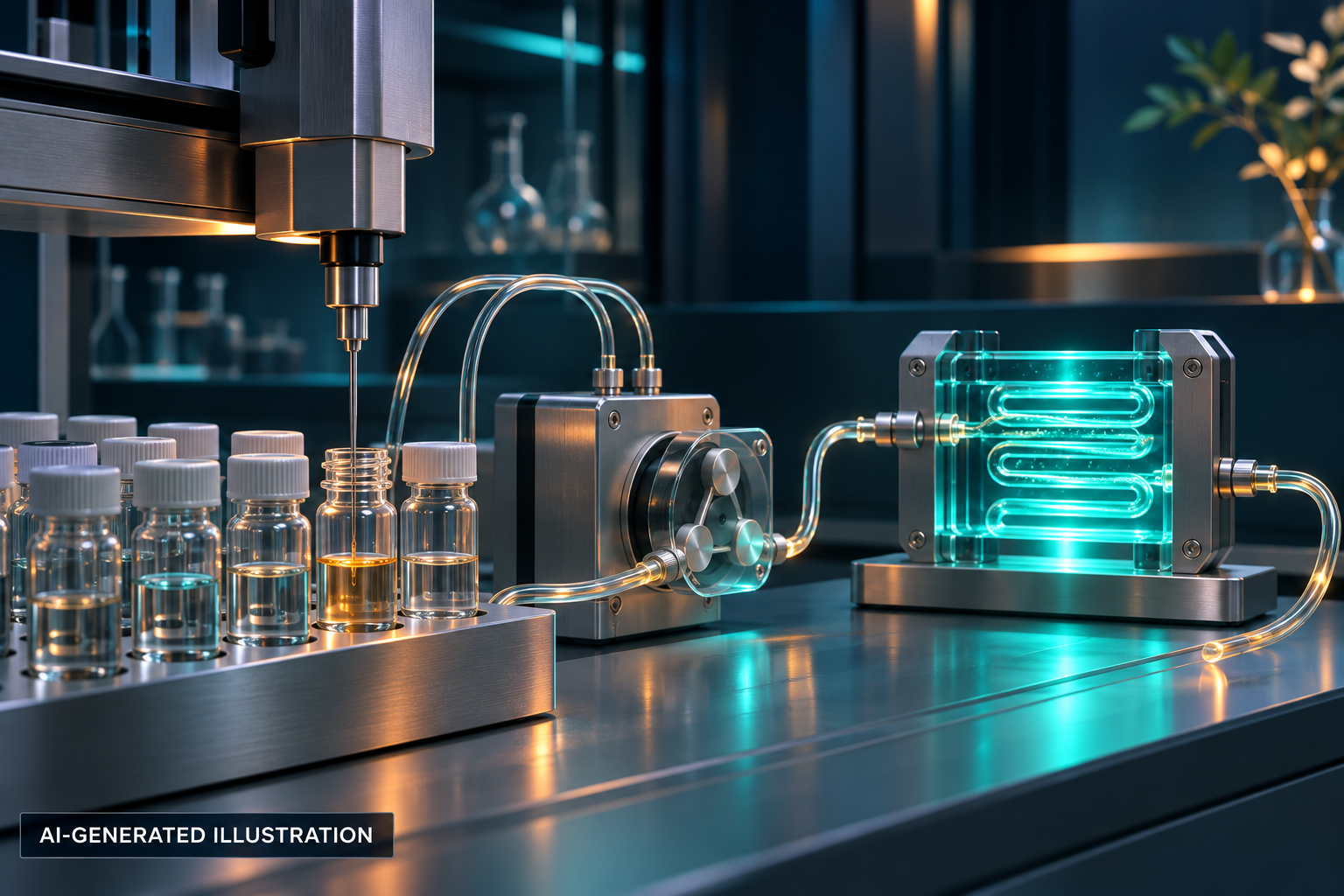
A robotic needle selects reagents and mixes a volume only slightly larger than half a millilitre. The mixture travels through narrow tubing into an LED-lit reactor, where light activates a photocatalyst. It then reaches an automated NMR instrument that measures the products. The benchtop platform links making a molecule and evaluating the attempt without stopping for each manual handover.
Sources: [1]
The useful surprise was sometimes dimmer light
The team expected that individually optimized conditions might outperform one recipe applied to many molecules. That proved productive: for some reactions RoboChem selected unexpectedly low light intensity, while others benefited from more. Bayesian optimization used previous measurements to choose the next settings, searching for better yield or throughput within a space defined by the chemists.
The products were checked outside the machine
Researchers manually isolated and verified the molecules reported in the Science paper. In a comparison revisiting research from four selected papers, the university reported improved yields in about 80% of cases and similar yields in the remainder. This is evidence for the tested photocatalytic reactions, not proof that a robot outperforms every chemist or every synthesis method.
Failed reactions become part of the knowledge
RoboChem records unsuccessful conditions as well as successful ones, preserving information often absent from published chemistry. The system also explored scale-up in its flow reactor. Humans still choose the search boundaries, prepare stock solutions and isolate products. Its contribution is a repeatable experimental partner that turns many small attempts into usable chemical knowledge.
The original sources
- University of AmsterdamAutonomous synthesis robot uses AI to speed up chemical discovery
- Noël Research Group, University of AmsterdamHow our team created RoboChem
- Science / University of Amsterdam repositoryAutomated self-optimization, intensification, and scale-up of photocatalysis in flow