BIGGER PICTURE Public & everyday services
A driverless-car safety claim checked against insurance records
The important question about a robotaxi is not whether it looks futuristic. It is whether people outside and inside the vehicle face less harm. A Waymo–Swiss Re study used liability claims to make that question measurable.
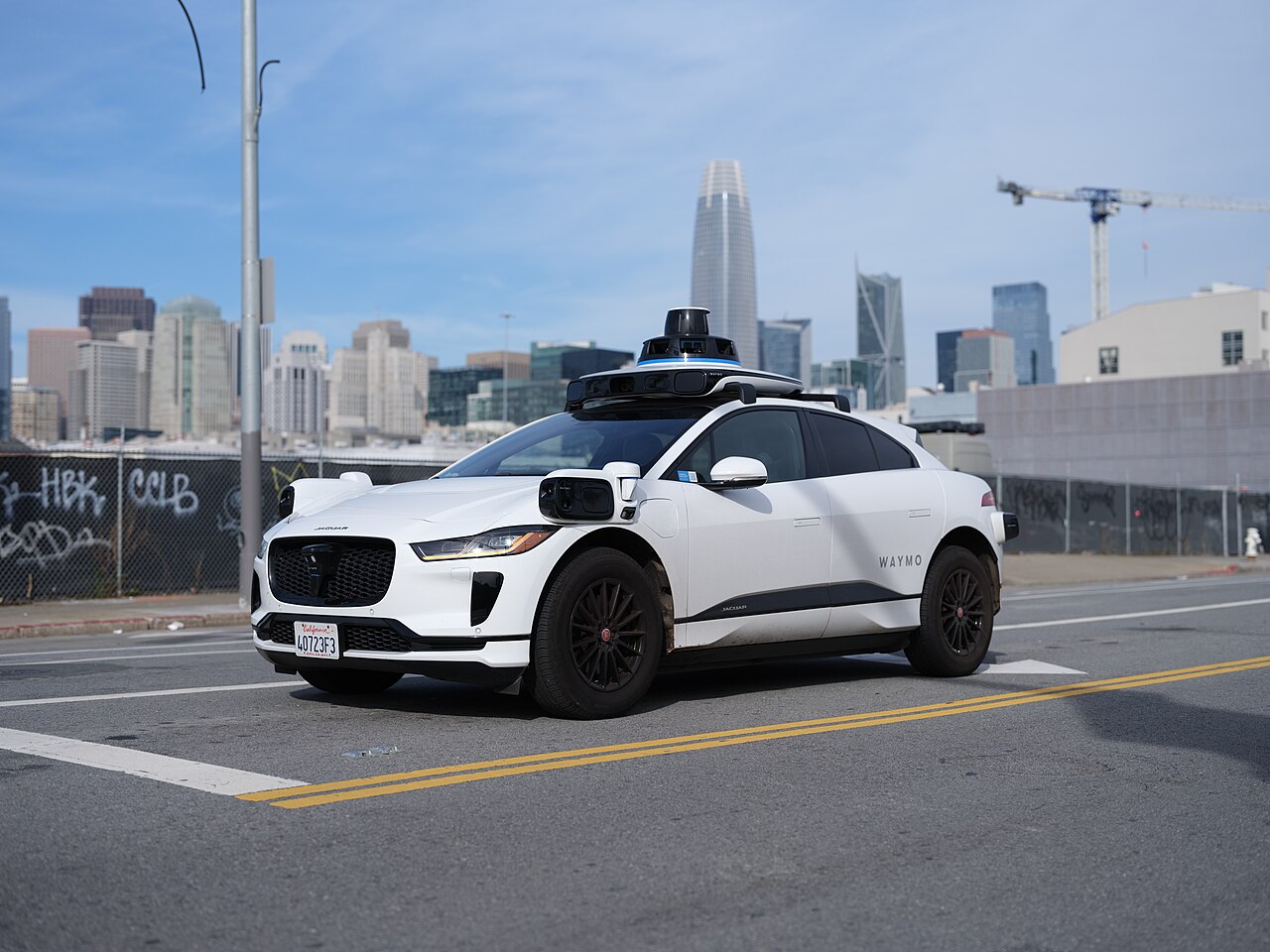 Original photograph
- Historical dataset
- 25.3 million driverless miles, through July 2024
- Property damage
- 88% fewer liability claims than the baseline
- Bodily injury
- 92% fewer liability claims than the baseline
How the idea works
Sense the whole road scene
Cameras, lidar and radar describe surrounding traffic.
Predict and plan movement
Onboard software identifies objects and chooses a driving path.
Audit real-world outcomes
Liability claims are compared with geographically calibrated human exposure.
A continuous view around the vehicle
Waymo combines cameras, lidar and radar with onboard computation. The sensors contribute complementary information about surroundings, distance and motion; software identifies road users and plans vehicle movement. This mechanism can support safer driving, but a technical description alone cannot establish that it does. The claim must be tested against what happens on roads.
Sources: [3]
Compare like places and driving exposure
Swiss Re and Waymo examined 25.3 million fully autonomous miles from January 2018 through July 2024 in four US operating areas. They calibrated human-driver insurance benchmarks to geography and mileage. The approach asked about liability claims, a proxy for responsibility in harmful collisions, rather than comparing a robotaxi demonstration with a national headline statistic.
Sources: [1]
Nine property claims and two injury claims
The study reported nine property-damage and two bodily-injury claims in the Waymo dataset, compared with approximately 78 and 26 expected from its overall human benchmark. Those differences correspond to reductions of 88% and 92%. At the reporting date, the two injury claims were still open. These are claims counts, not a count of every collision.
Sources: [2]
Strong evidence needs a defined boundary
This company-linked observational study supports a safety benefit within the studied operations. It does not prove safety on every road, in every weather condition or for every automated-driving system. Its most useful example is methodological: publish exposure, comparison rules and harm-related outcomes, so optimism can be examined rather than accepted on appearance.
Sources: [1]