BIGGER PICTURE Nature & food
Open the nozzle for the weed, not the whole field
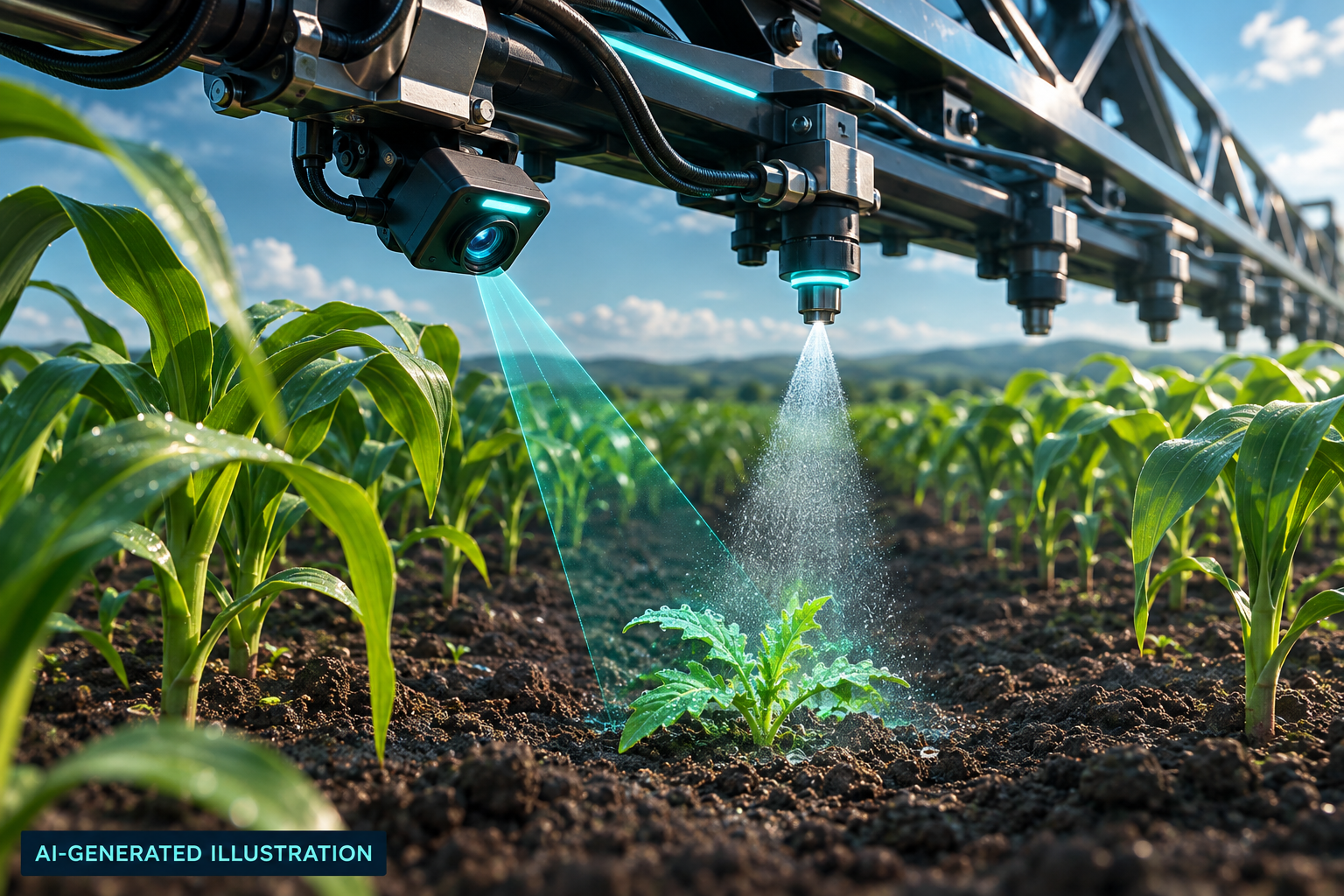
A moving sprayer can make a small decision hundreds of times: is there a weed under this nozzle? That changes where herbicide goes—and makes missed weeds an important part of the story.
- Arkansas three-year trial
- 43–59% less post-emergence herbicide
- Nebraska test machine
- 36 cameras · 96 nozzles
- Critical trade-off
- Savings versus escaped weeds
How the idea works
See plants beneath the boom
Cameras distinguish potential weed targets.
Open selected nozzles
Herbicide reaches detected targets rather than all ground.
Check survivors and seeds
Field results reveal whether savings preserved weed control.
A long boom makes many tiny decisions
In a separate Nebraska study, the John Deere 612R carried 36 cameras and 96 nozzles along a 36.6-metre boom. Cameras detected weeds so foliar herbicide could be applied selectively. The machine could also carry a separate soil-residual treatment. This is not simply turning all spraying off between crop rows: different treatments and targets can coexist on the same pass.
Sources: [2]
What the soybean trial measured
University of Arkansas researchers tested See & Spray over three years beginning in 2022. Against broadcasting herbicide across the whole field, the study reported 43–59% less post-emergence herbicide use. That is a measured application saving in these trials, not a universal reduction for every pesticide, farm or season. Weed distribution and the operator's settings influence the result.
Sources: [1]
The cheapest setting can create next year's problem
Lower sensitivity saved more spray but missed smaller weeds. In the Arkansas work, escapes produced seeds; the lowest setting was associated with a sharply growing soil seed bank. A weed that survives today can increase future control costs. The useful optimisation target therefore includes several seasons of weed control, not just the smallest chemical bill on one afternoon.
Sources: [1]
The opportunity depends on empty space
The Nebraska researchers likewise found that savings depended strongly on weed pressure. Sparse weeds leave more ground where a nozzle can stay closed; dense infestations leave less. For growers, this offers a practical way to reduce unnecessary application while retaining agronomic judgement. The inspiring change is spatial precision: treat the object that needs treatment, then verify the biological consequences.
Sources: [2]
The original sources
- University of Arkansas System Division of AgriculturePrecision agriculture research measures effectiveness of See & Spray technology
- Leise et al.; Agrosystems, Geosciences & EnvironmentEvaluating precision sprayers for targeted weed management in corn and soybean