BIGGER PICTURE Nature & food
Why the crop-diagnosis app asks for six leaves
One leaf can tell the wrong story. Nuru's most interesting improvement was not a more impressive slogan about AI—it was learning where on the plant to look.
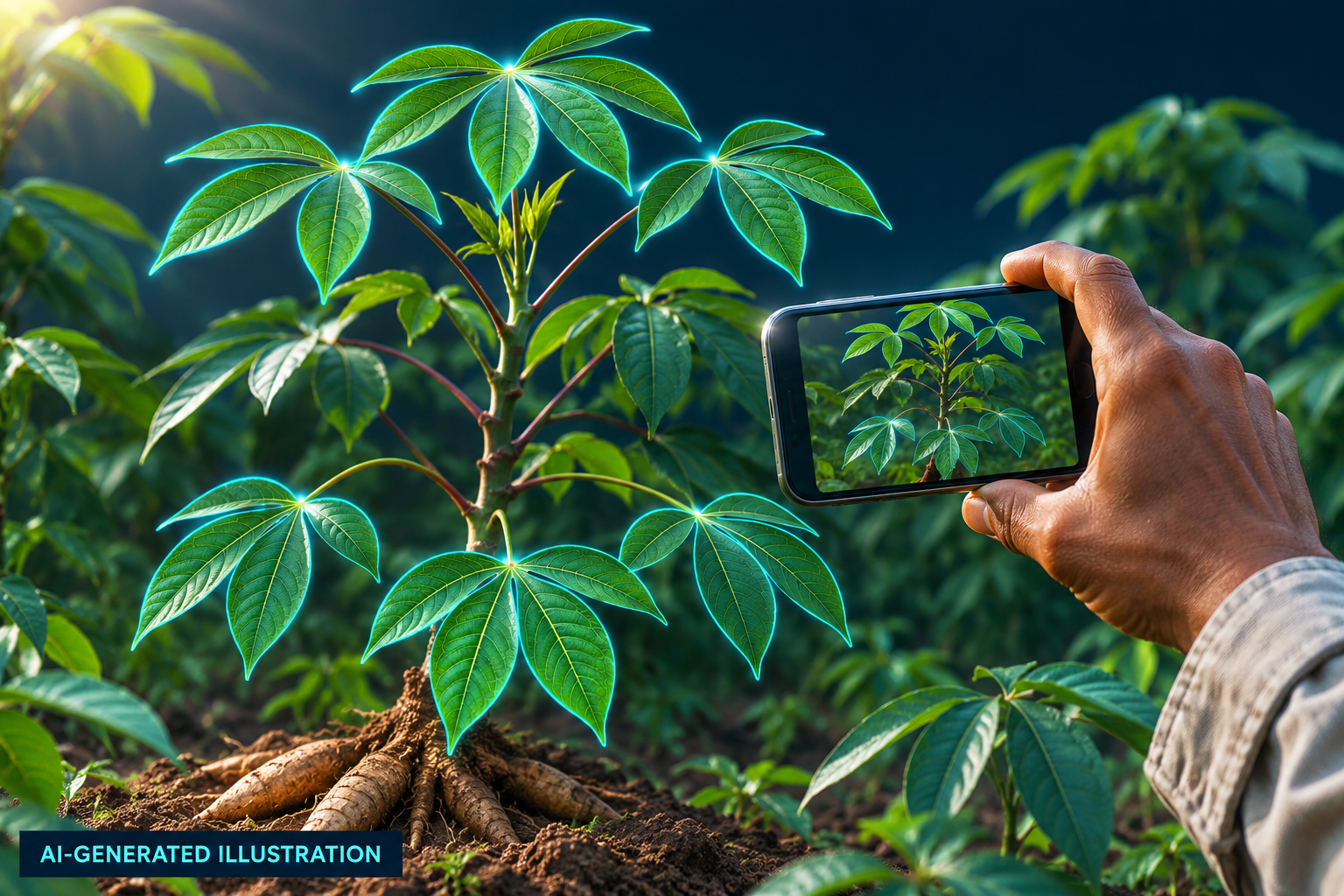
- Practical inspection
- 3 upper + 3 lower leaves
- Connectivity
- Diagnosis works offline
- Evidence
- Tanzanian field evaluation, 2020
How the idea works
Inspect upper and lower leaves
The user shows several parts of the plant.
Recognise visible symptoms locally
The phone runs the model without a network.
Interpret with agronomic advice
The finding supports a field decision, not a certainty.
Bring recognition to the field
Cassava provides food and livelihoods, but identifying disease symptoms requires expertise that is not always nearby. IITA and Penn State developed Nuru to recognise visible leaf damage on an ordinary Android phone. The model runs offline, so weak mobile coverage need not prevent an initial inspection. It assists a grower or extension worker at the plant itself.
Sources: [2]
A focused leaf becomes a diagnostic clue
Users point the camera at a leaf and obtain a classification of visible symptoms. The original cassava work addressed mosaic disease, brown streak disease and mite damage. The PlantVillage system also connects diagnosis with advice and, when connectivity permits, access to experts. That practical connection matters: recognising a pattern is useful when someone can understand what to do next.
Different problems appear on different leaves
The 2020 field study found that inspecting several leaves improved performance. Some symptoms are clearer on younger upper leaves, others lower on the plant. Researchers adopted six leaves—three above and three below—to improve the chance of seeing the relevant signs. The lesson is unusually tangible: better sampling of the living plant can matter as much as the classifier.
Sources: [1]
Recognising symptoms is not proving a harvest gain
Nuru was evaluated against expert assessments, and performance differed between conditions and sampling methods. A visually healthy leaf cannot guarantee an uninfected plant. Nor did this evaluation establish a percentage increase in farmers' yields. The human benefit demonstrated here is more accessible diagnostic assistance; sustained crop protection still depends on correct interpretation, suitable action and local agricultural support.
The original sources
- Frontiers in Plant ScienceAccuracy of a Smartphone-Based Object Detection Model, PlantVillage Nuru, in Identifying the Foliar Symptoms of the Viral Diseases of Cassava–CMD and CBSD
- International Institute of Tropical AgricultureAfrican farmers get new help against cassava diseases: Nuru
- Penn State UniversityGrant will support expanded use of artificial intelligence for crop health