BIGGER PICTURE Nature & food
The wind turbines that pause when an eagle approaches
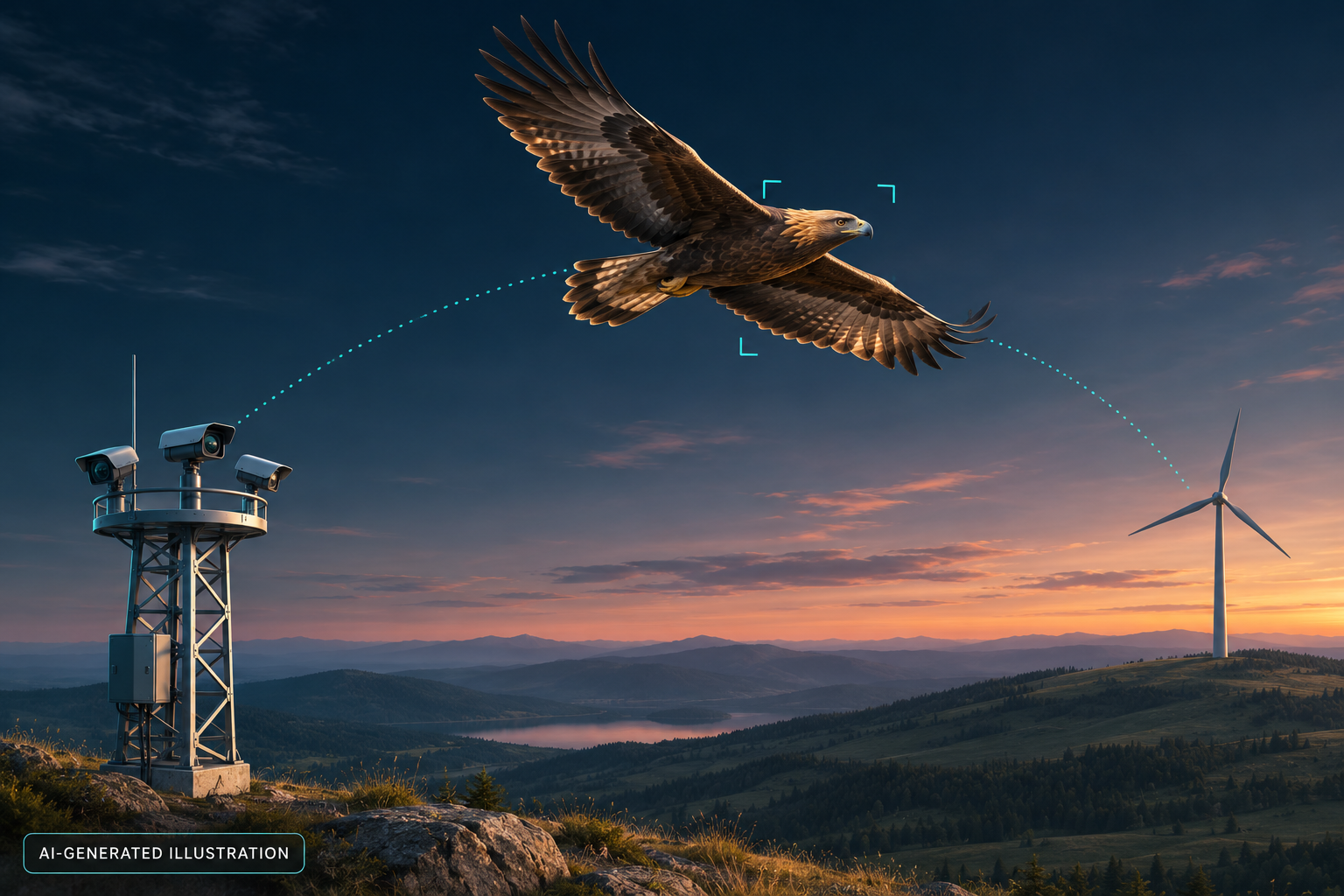
A camera identifies an approaching eagle, estimates its flight path and asks specific turbines to pause. The useful invention is the link between seeing wildlife and changing the machine.
- Estimated fatality reduction
- 85% at the studied site
- Uncertainty interval
- 12–100% · 95% HDI
- Evidence design
- Before/after plus control site
How the idea works
Track an approaching bird
Wide and stereo cameras establish motion and distance.
Assess the collision path
Classification and trajectory identify a turbine at risk.
Pause the relevant blades
The control network receives a targeted curtailment command.
First find the bird, then measure its approach
IdentiFlight uses wide-view cameras to notice movement and stereo cameras to track a bird more closely. Like two eyes, the paired views help estimate distance. Neural networks classify the bird while the system calculates its position and trajectory. That matters because a distant bird crossing safely behind a turbine presents a different problem from an eagle approaching rotating blades.
Change the turbine, not the eagle
The curtailment module compares the flight path with turbine positions and can send a shutdown command through the wind farm's control network. This targets particular turbines rather than automatically stopping an entire wind farm whenever a bird appears. Installation still requires ecological and site planning. Cameras, classification and a working control connection must function together for recognition to become protection.
Sources: [3]
What happened at the Wyoming site?
A 2022 reanalysis compared eagle fatality rates before and after automated curtailment at a Wyoming wind facility, using a separate control site. The estimated reduction was 85%. The authors also widened the uncertainty interval to a more realistic 12–100% and restricted comparisons to matching turbine types. That careful revision is part of the evidence, not a footnote to hide.
Sources: [1]
Protect wildlife while keeping useful generation
Stopping blades costs electricity production; failing to stop can cost wildlife. This case makes that trade-off more selective. It does not establish the same reduction for every species, landscape or operating rule. For communities planning renewable energy, the compelling possibility is infrastructure that reacts to its surroundings, with performance checked through wildlife outcomes rather than camera accuracy alone.
The original sources
- Ecological Solutions and Evidence; author paper hosted by PNNLConfirmation that eagle fatalities can be reduced by automated curtailment of wind turbines
- IdentiFlight / Boulder ImagingIdentiFlight: core technology
- IdentiFlight / Boulder ImagingHow Does IdentiFlight Work?