BIGGER PICTURE Public & everyday services
Try the next train decision before making it
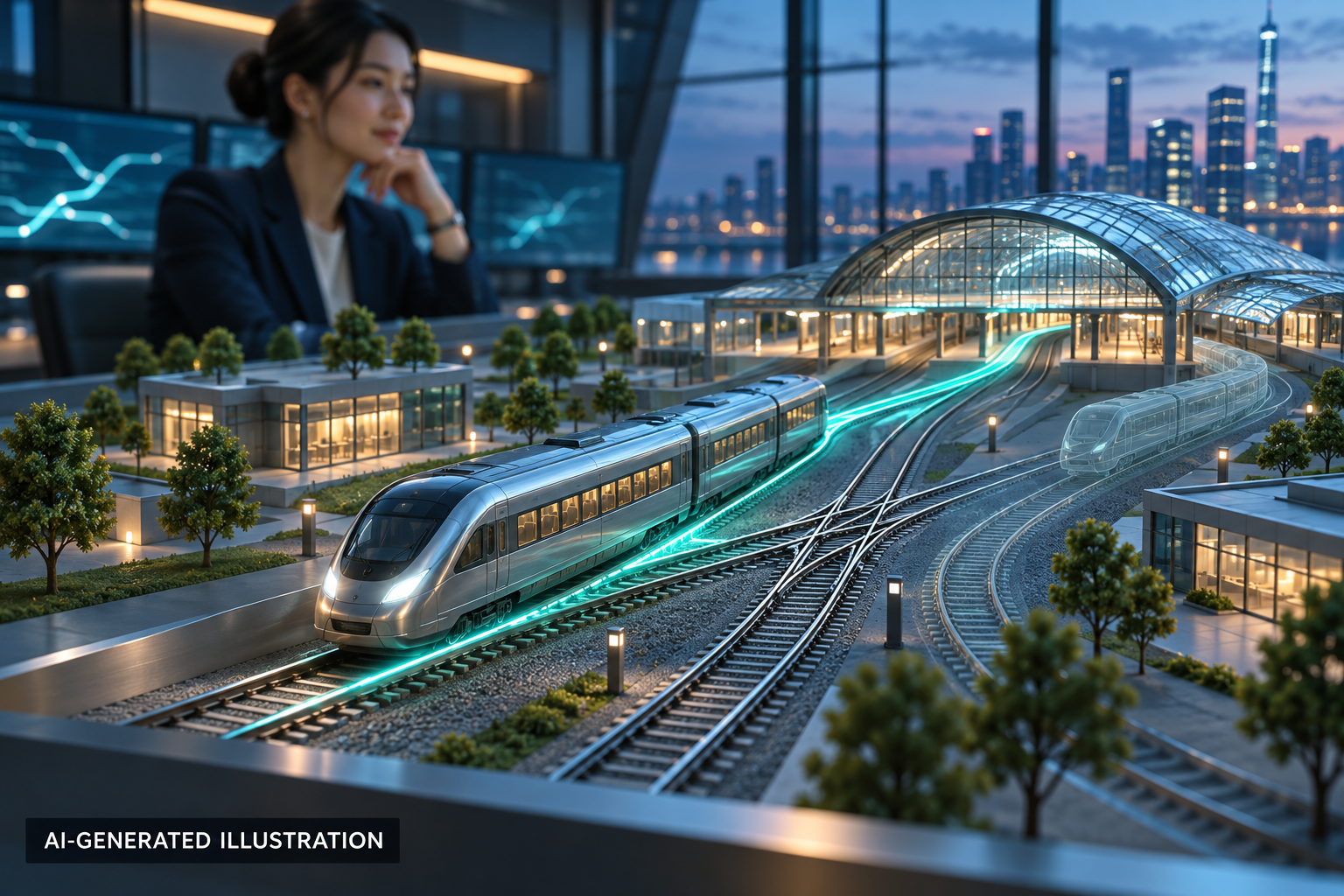
A delayed train can disturb several others. KI-Dispo helps control-room staff explore what happens next, using a live simulation to turn a complex operating situation into concrete suggestions.
- DB-reported avoided delay
- About 95,000 train-minutes in 2025
- Operating context
- S-Bahn control rooms
- Tool role
- Dispatch assistance
How the idea works
Mirror live rail operations
Current train movements initialize the operating model.
Explore dispatch interventions
Simulation estimates consequences of alternative actions.
Support the control room
Dispatchers receive actionable conflict-reduction suggestions.
A local delay can propagate
Rail dispatch is a sequence problem: when trains share constrained track space, changing one movement can affect the next. KI-Dispo is designed as an assistant for the people managing those interactions. Deutsche Bahn’s 2025 report describes a system that processes the live operating situation in seconds and warns of emerging conflicts.
Sources: [1]
Let the simulation test the suggestion
DLR’s technical account shows why simulation is central. It represents normal operations, delayed operations and operations after an intervention. Proposed actions can be tested before being shown to dispatchers, with predicted subsequent delay as a useful outcome. The earlier research also used simulated feedback to train reinforcement-learning decision strategies.
Sources: [2]
A railway action, not a vague recommendation
The development material includes changing train order and adapting vehicle circulation among the possible interventions. Such choices have practical constraints involving infrastructure, schedules and available resources. The tool must translate its search into actions a dispatcher can understand and assess. Its role is therefore closer to an operational rehearsal than a conversational chatbot.
Sources: [2]
What 95,000 minutes does—and does not—mean
DB reports roughly 95,000 avoided delay minutes in 2025, with pilots in Stuttgart, Rhein-Main and Munich and a Berlin pilot added that year. This is an operator-reported train-delay measure, not 95,000 passenger-hours or proof that the entire railway became punctual. It documents useful assistance within particular networks while the system continues to be developed.
Sources: [1]
The original sources
- Deutsche BahnDigitalisierung und Technik: Geschäftsbericht 2025
- DLR / Jakob ErdmannSimulation als Baustein für KI-Anwendung in der Disposition