BIGGER PICTURE Disaster preparedness
Forecasting a downpour without blurring it away
A generative weather model tackles an awkward problem: averaging several possible storms can produce a smooth forecast of a storm that never happens.
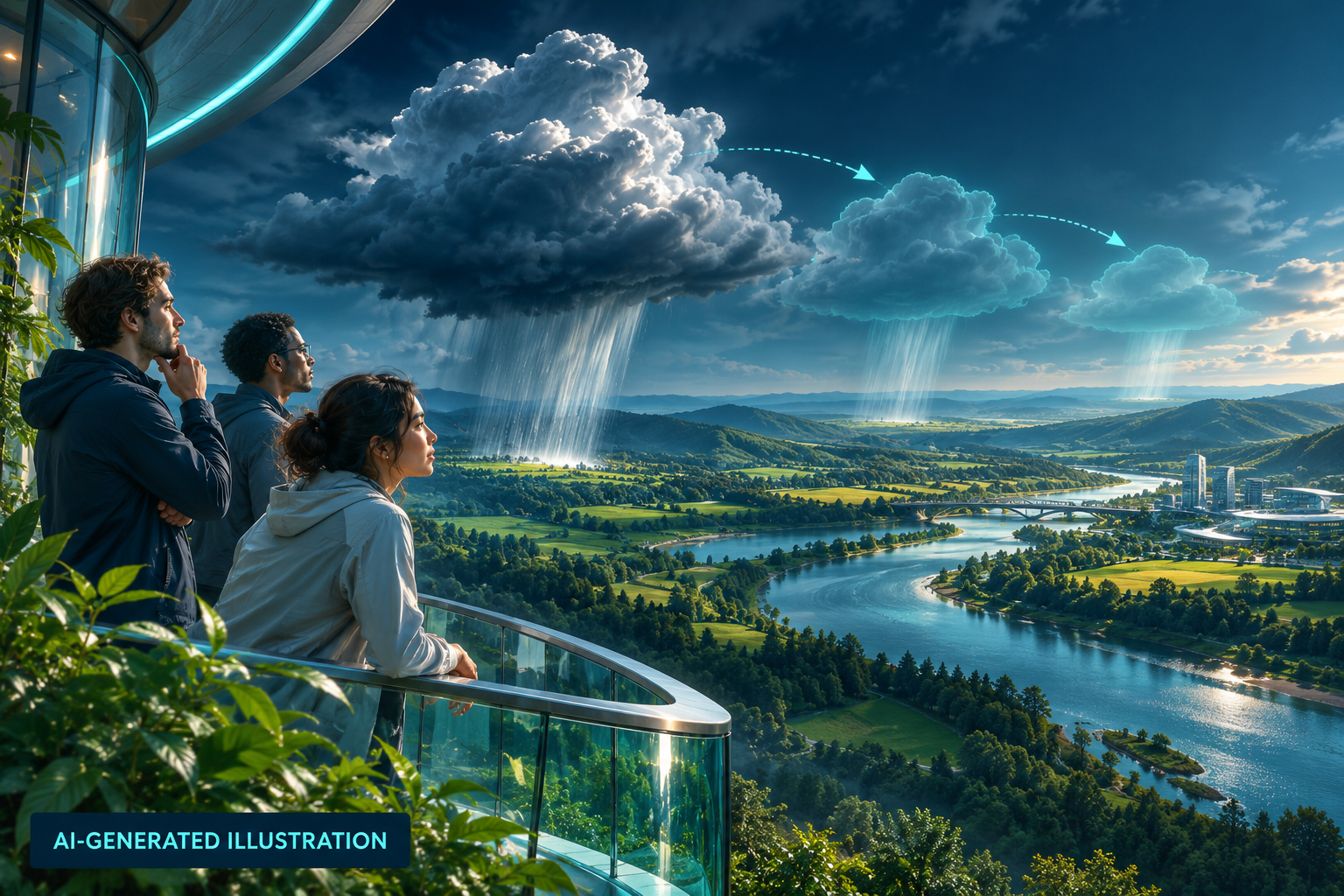
- Lead time
- 5–90 minutes
- Expert evaluation
- More than 50 Met Office forecasters
- Approach
- Several plausible radar futures
How the idea works
Read recent radar
Radar sequences show how rain has moved and changed.
Generate possible continuations
The model produces coherent future rain patterns.
Compare and interpret
Forecasters assess location, intensity and uncertainty.
A blurred storm can hide the dangerous bit
A weather forecaster needs to know where intense rain may fall in the next hour, not just whether the wider region will be damp. Some machine-learning forecasts become blurry as they look further ahead. Averaging possible storm positions can soften the very peaks that matter for decisions about heavy rain, transport and local flood risk.
Generate plausible weather, then test it
DeepMind and the Met Office developed DGMR to generate multiple realistic continuations of recent radar observations. Rather than presenting one smoothed answer, the system represents several possible ways rain could evolve. Its predictions cover lead times from five to ninety minutes. The research checks both numerical skill and whether the resulting structures make sense to professional forecasters.
The people using the forecast got a vote
More than fifty Met Office meteorologists compared the model with two alternatives in a systematic evaluation. They strongly preferred the generative forecasts for accuracy and usefulness; the final publication’s accompanying account reports first preference in 89% of cases. That percentage describes expert preference in a comparison, not the probability that any future forecast will be correct.
Useful uncertainty beats false precision
The Met Office describes the work as a demonstration evaluated against standard methods. It is evidence of a useful forecasting approach, not proof that this particular 2021 model now issues public warnings or has prevented a quantified loss. Its transferable contribution is showing uncertainty in a form experts can interpret without erasing the physical intensity of possible events.
The original sources
- Ravuri et al., arXiv; published in NatureSkillful Precipitation Nowcasting using Deep Generative Models of Radar
- NatureSkilful precipitation nowcasting using deep generative models of radar
- Google DeepMindNowcasting the next hour of rain
- Met OfficeA framework for data science in the Met Office 2022–2027