BIGGER PICTURE Scientific discovery
Teaching AI to invent a shorter way to multiply
Many digital tasks reduce to multiplying grids of numbers. AlphaTensor searched for new recipes for that operation—and produced answers that mathematicians and programmers could verify.
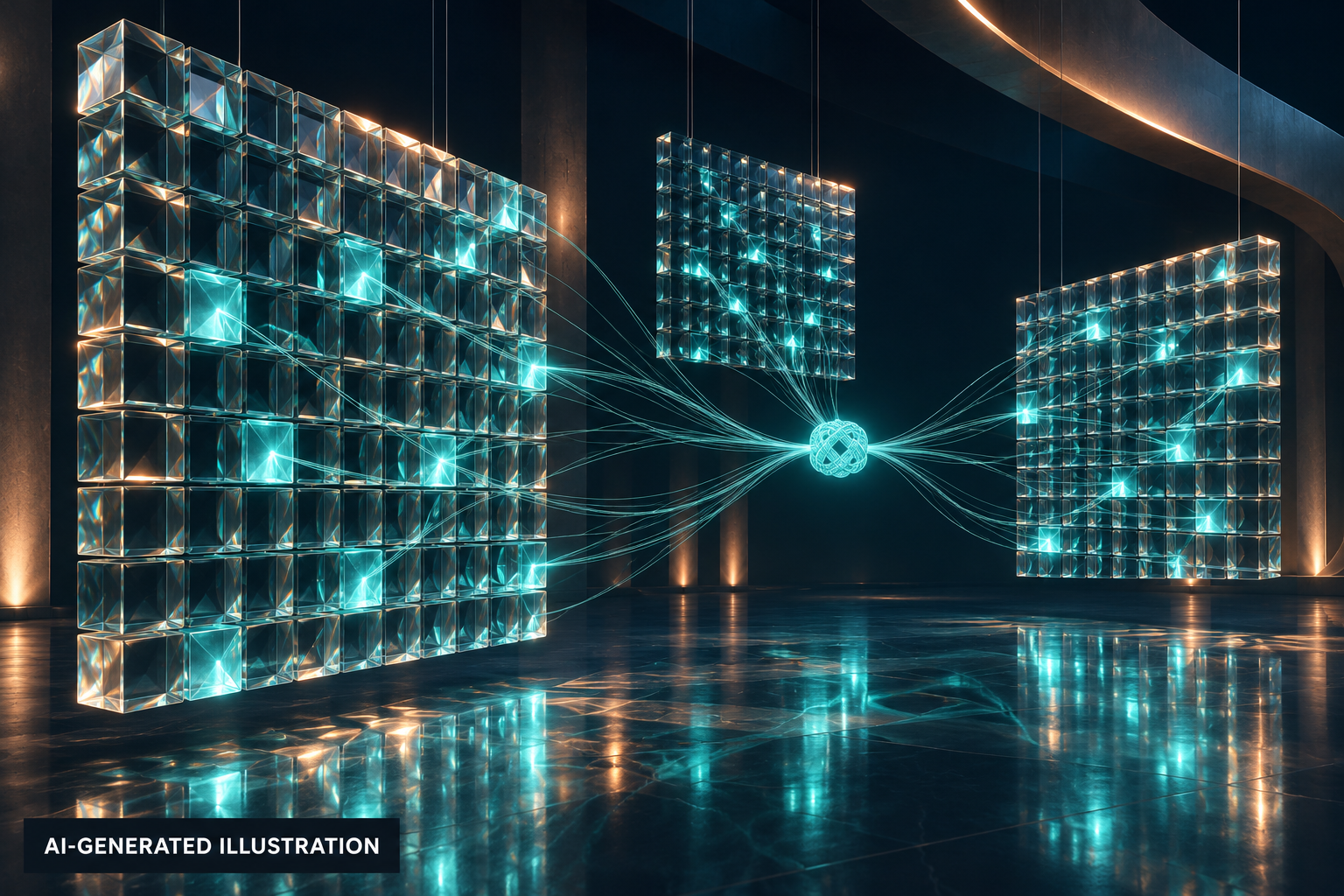
- Concrete example
- 76 multiplications instead of 80
- Example dimensions
- 4×5 multiplied by 5×5
- Hardware experiments
- 10–20% faster in specified benchmarks
How the idea works
Encode unfinished multiplication
A tensor records the calculation still to reproduce.
Find a shorter exact recipe
Reinforcement learning searches combinations that reduce it to zero.
Verify and time the result
Algebraic checks and hardware benchmarks assess each algorithm.
A familiar operation with hidden possibilities
Matrix multiplication helps computers manipulate images, calculate simulations and train neural networks. The standard method is straightforward, but not always the most economical. AlphaTensor found a recipe for multiplying a 4-by-5 matrix by a 5-by-5 matrix using 76 multiplications, improving on a previously known 80-step method; the textbook approach uses 100.
Sources: [1]
Turn the remaining work into a game board
The researchers represented the calculation as a three-dimensional array of numbers. Each move removed part of the remaining computation. Reaching an all-zero board meant the proposed recipe exactly reproduced the intended multiplication. Reinforcement learning searched for short successful games, converting an enormous space of possible formulas into a problem with an unambiguous finish line.
Sources: [1]
A mathematically short recipe is not always fastest
Practical speed also depends on the processor. The team therefore fed measured hardware performance back into the search. It reported 10–20% faster multiplication in selected Nvidia V100 and TPU v2 experiments. The released repository includes a V100 benchmark script, so the result is connected to a concrete machine and test rather than a universal speed promise.
Publish the recipe, not only the headline
The project released discovered algorithms, verification notebooks and thousands of distinct solutions for one matrix problem. Researchers can inspect and build on them without trusting a fluent AI explanation. This is foundational research: it offers new computational building blocks, but does not demonstrate a 20% saving for an entire scientific workflow or every application.
Sources: [2]
The original sources
- Google DeepMindDiscovering novel algorithms with AlphaTensor
- Google DeepMindAlphaTensor: algorithms, verification notebooks and benchmarks