BIGGER PICTURE Better care
A brain pacemaker that changes with the medication cycle
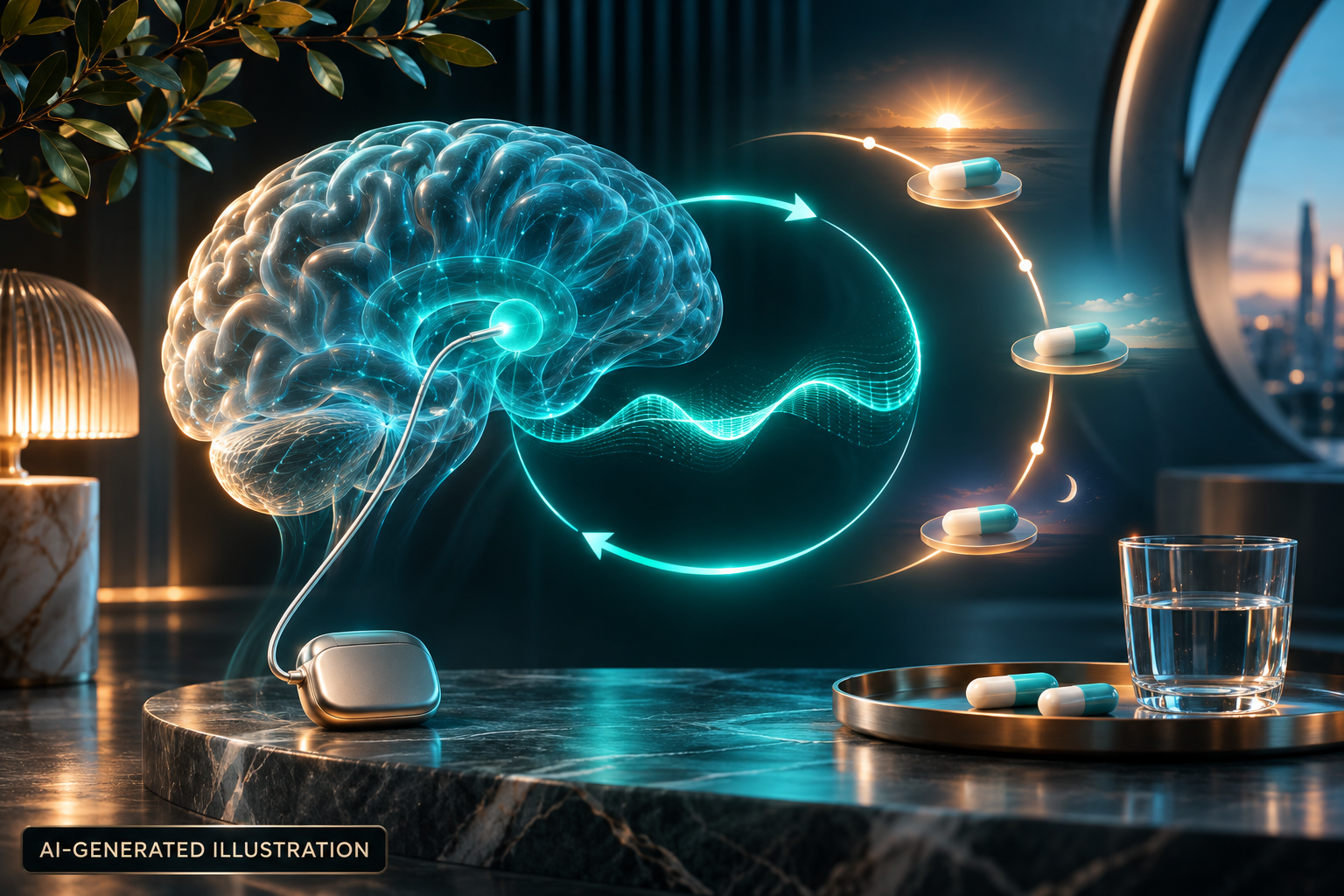
Parkinson’s symptoms fluctuate as medication takes effect and wears off. UCSF researchers tested a brain implant that adjusts stimulation to the person’s changing state instead of delivering a fixed level all day.
- Participants
- Four people
- Comparison
- Adaptive versus conventional stimulation
- Reported symptom change
- About 50% less of the most bothersome symptom
How the idea works
Identify a personal signal
Brain recordings reveal patterns linked to the person’s symptoms.
Sense the changing state
The implant monitors those patterns during daily activity.
Adjust stimulation
Electrical pulses change as the symptom state changes.
Too little and too much can both be a problem
Medication and electrical stimulation work together to control Parkinson’s movement symptoms. When medication is active, too much additional stimulation can contribute to excess movement; when it wears off, stiffness can return. A constant setting must compromise across these changing needs.
Sources: [1]
Find the signal that matters for this person
The research used AI-derived methods to identify brain-activity patterns linked to each participant’s symptoms. The implanted system monitored those signals and adjusted electrical pulses accordingly. Participants could switch out of adaptive mode or stop stimulation using a handheld controller.
Test the setting during ordinary life
Four people compared adaptive stimulation with conventional constant stimulation in the trial reported in 2024. Each identified the symptom that bothered them most. The researchers reported roughly a halving of that symptom with the adaptive approach while participants went about daily life.
Personalisation is the result to take seriously
Four participants cannot establish how broadly the approach will work, and an implanted treatment still requires surgery and specialist care. The demonstration nevertheless changes the design question: instead of finding one good setting, can the device keep finding the right setting as the person changes?
The original sources
- University of California, San FranciscoTaming Parkinson’s Disease with Intelligent Brain Pacemakers
- Nature MedicineChronic adaptive deep brain stimulation versus conventional stimulation in Parkinson’s disease